
The Costliest Africa Mistakes Are Made Before Entry
Failure becomes visible in the market, but the decision that made it likely may have been taken months earlier – when leaders approved the premise, partner, structure, timetable or operating model.

Failure begins before it is visible
By the time an African venture visibly fails, the story is usually told backwards. A partnership breaks down, a permit never arrives, costs rise or a project stalls after funds are committed. The post-mortem focuses on whatever happened in-market in the weeks before the crisis became undeniable.
That is where the pain appears. It is rarely where the mistake was made.
The decisive error may sit in the original board paper: the assumption that demand would compensate for institutional friction, a prominent partner would resolve execution risk, the legal entity would operate as designed, or approvals would fit a commercial timetable.
By the time it is disproved, capital is committed, expectations announced and relationships costly to change.
Visible failure is late evidence of an early decision.
Deon Führi
What the board is really approving
A market-entry decision appears to concern geography. In reality, the board is approving a chain of linked propositions:
The selected market is the right expression of the opportunity.
The proposed partner will remain capable and aligned.
The legal structure supports the intended operating model.
The institutions on which execution depends can make and sustain the required decisions.
The timetable reflects administrative and political reality.
The business can absorb delay, renegotiation and learning without destroying its economics.
Each proposition needs its own evidence. Aggregating them into “the market is attractive” hides the assumptions most likely to fail.
The broader evidence reinforces this point. The World Bank distinguishes institutional function from form and stresses commitment, coordination and incentives. The IMF assesses both the design and practical effectiveness of public-investment institutions. Good rules and attractive economics matter, but neither is self-executing.
Market selection: need is not enough
Large unmet need is compelling. It can also be misleading. A country may need more electricity, logistics, finance, housing or healthcare. That does not mean the proposed customer can pay, the tariff can hold, the supply chain can function or operating approvals can be secured at the necessary pace.
CASE IN POINT : NAMIBIA
I saw this tension clearly in Namibia during a green-hydrogen discussion in 2025. The country’s renewable resources, institutional credibility and international interest created a persuasive proposition. The harder question was whether the full chain – production, conversion, transport and final demand – could support the economics. Resource advantage did not remove distance, conversion losses or dependence on an offtaker in another market.
The lesson is broader than hydrogen. Market selection must be based on the full delivered model, not the most attractive part of the value chain. Opportunity can disappear when dependencies between production and payment become explicit.

Partner selection: define the risk being reduced
Local partnership is often presented as a general answer to local complexity. It is not. A partner should address a specific constraint: customer access, distribution, technical delivery, regulatory understanding, capital, stakeholder management or operations.
The board should state which risk the partner is being selected to reduce and how performance will be measured.
Connections may open doors, but they do not maintain equipment, collect revenue, manage a workforce or guarantee alignment after the first payment.
WHICH RISK IS THE PARTNER ACTUALLY REDUCING?
Partner diligence should examine contribution, capacity and consequence. What must each party contribute after entry? What capability has been demonstrated in comparable work? What follows non-performance? Decision rights, funding obligations, conflicts and exit arrangements should be designed before goodwill is tested.
The expensive moment to discover misalignment is after the partner has become the channel through which the entire market operates.


Legal structure versus operating structure
Legal advice is essential, but a legally valid entity is not an operating model. The legal structure establishes ownership, liability and formal authority. The operating structure must explain who decides, hires, pays, owns customer relationships and escalates disputes.
I have seen immaculately drafted arrangements leave nobody with genuine operating authority in-market. The people who negotiated control were not those expected to decide on a difficult Friday afternoon. The contract described the relationship; it did not create the standing or resources the operation needed.
The same distinction applies to public institutions. An agency may have a mandate but lack the budget or authority to coordinate other ministries. A regulator may be independent in law but exposed during a difficult tariff decision. A state-owned counterparty may be authorised to contract but unable to meet current obligations.
The question is not merely whether an institution can sign. It is whether it can decide, pay, enforce and sustain.
A successful entry creates an execution container
Morocco’s Noor Ouarzazate solar programme illustrates the value of resolving operating interfaces before asking investors to carry them. Morocco created MASEN as a specialised institution with a mandate across important aspects of preparation and implementation. Land, grid connection, water, procurement and financing were not treated as unrelated workstreams that would somehow converge after award.
I remember a conversation in Casablanca with a European financier who was struck by how much coordination had already been settled. Complexity had a capable owner.
The investor still had to evaluate technology, price and construction risk, but did not have to invent the sovereign coordination system on which the project depended.
The lesson extends beyond energy: successful entry is more likely when material exposures are assigned to actors with the authority, incentives and resources to carry them.

When the model travels but the system does not
I have also seen the opposite pattern in the regional energy sector. One country completed a renewable-energy tender with substantial donor and development-finance support. Officials from another country studied it, retained similar expertise and adopted similar tender documents. The second process did not progress as expected.
The paperwork was not the problem. The receiving market lacked the same combination of credible offtaker, regulatory capability and treasury alignment. It had imported a transaction design without the conditions that made the original workable.
The early decision that could have changed the outcome was to test the receiving system before committing to the tender timetable: identify who could own coordination, confirm the offtaker’s performance, secure treasury participation and resolve critical regulatory dependencies. If those conditions could not be created, the structure or timing should have changed before inviting the market to respond.
Timelines are institutional assumptions
Entry plans often treat time as a project-management variable. In institutional settings, time is also political and administrative.
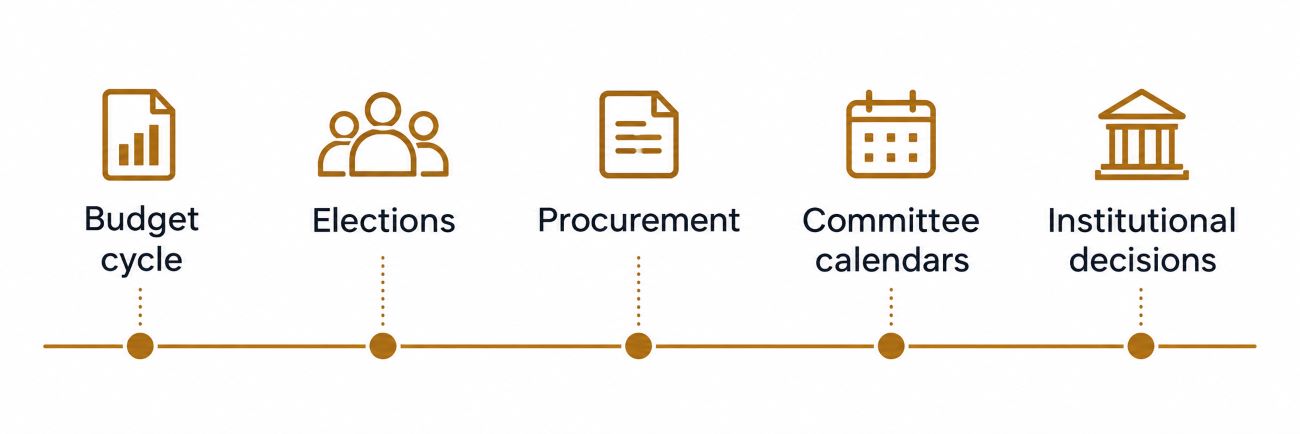
Budget cycles, elections, procurement rules and committee calendars determine when decisions are possible. A three-month commercial target is not credible if several public institutions must act in sequence and nobody owns escalation.
Institutional capacity does not expand to fit a foreign investor’s calendar. Map the decisions, decision makers, budget windows and consequences of delay, then test whether the business remains viable.
Speed that depends on exceptional intervention is not a repeatable operating model.
What becomes costly after entry
Some choices harden quickly:
equity and control rights embedded in a partner agreement
a legal entity whose governance does not match operating reality
public commitments that make a slower timetable politically difficult
technology or assets that depend on an unready supply chain
customer pricing based on an approval that has not been institutionally tested
reliance on one champion, intermediary or decision route
sunk costs that turn a weak case into an emotional commitment
The purpose of a pre-entry test is to preserve options while changing course is still affordable.
A five-question pre-entry test
Before approving entry, I would require clear answers to five questions:
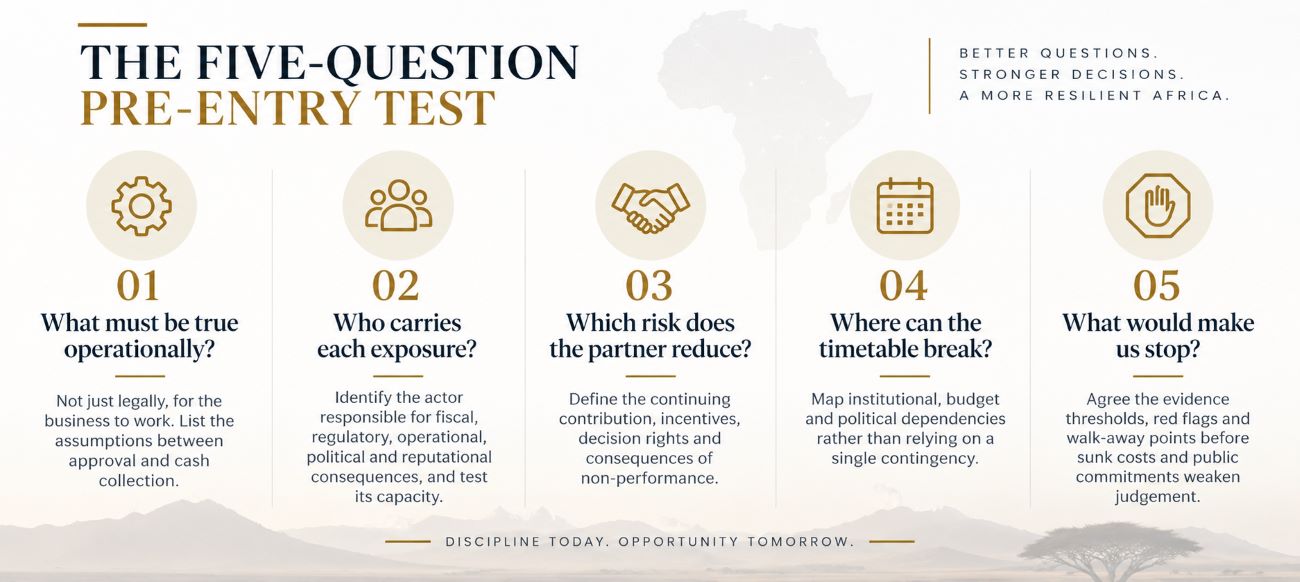
The fifth question is often avoided. Yet the ability to stop, rescope or delay is execution discipline. Walking away from an unready structure is not failure. Entering because too much has already been spent often is.
The costliest mistakes are made when confidence in the opportunity substitutes for evidence about the system. A better entry decision joins commercial analysis to institutional reality while the organisation still has choices.
If an African entry, partnership or project structure is currently before your institution, the next action is to run this five-question test before approval becomes difficult to reverse. Why Projects Fail When the Numbers Work provides the deeper execution framework. For the book, advisory enquiries or a direct conversation, click here.
Africa Is Not One Market. That Is Not the Most Dangerous Assumption.
The largest risks are rarely visible in a market-sizing slide. They sit in the institutions, relationships and decisions that determine
Why Projects Fail When the Numbers Work
Financial viability is necessary. It is not proof that the institutions, incentives and operating arrangements around a project are ready
The Costliest Africa Mistakes Are Made Before Entry
Failure becomes visible in the market, but the decision that made it likely may have been taken months earlier –